A Guide to the teaching programmes for Bolton GP Training resident doctors (2026)

Welcome (back) to the Bolton GP Training!
You can find out more about us and the regularly scheduled teaching on our website.
Lisa Diamond is our linked administrator and coordinates all of the various speciality programmes hosted at Bolton. Dr Reuben Pratheepan is our Training Programme Director.
Dr Kat Rothwell (ST1 & ST3) and Dr Seb Pillon (ST2 & ST3) lead the teaching programmes. Dr Sadiyah Kauser is the Differential Attainment champion (for those who need some extra support).
Teaching Programmes
- ST1 Teaching takes place on selected Thursday afternoons 1300-1600 at the Education Centre, Royal Bolton Hospital. The first session is on 3rd September 2026.
- An enhanced induction is also run in the initial weeks of August and those eligible will be invited directly.
- ST2 teaching takes place on selected Tuesday afternoons 1400-1700 at Horwich Health & Wellbeing Hub. The first session is on 8th September 2026.
- We also offer a 9-session Consultation Skills Course in ST2 on selected Tuesday afternoons 1400-1700 at Horwich Health & Wellbeing Hub. The first session is on 15th September 2026.
- ST3 teaching takes place on Wednesdays 0915-1600 at the Education Centre, Royal Bolton Hospital. The first session is on 26th August 2026.
You can find details of the schedule as well as lots of linked resources on our website.
What Teaching should I attend?
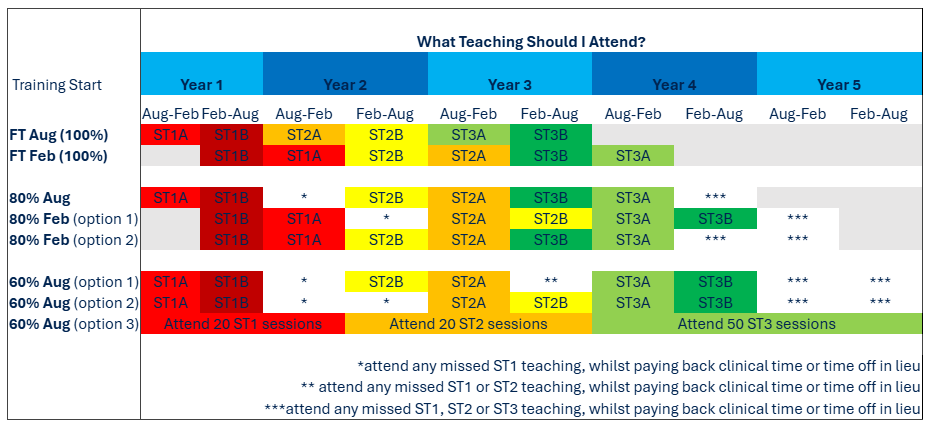
This is a common query and the short answer is: whichever you feel best suits your needs, in agreement with your Educational Supervisor.
The complex answer requires an understanding of the 30:70 educational:clinical split in your paid hours and the fact that attending 60/70/80% of a teaching session and leaving before the end is ridiculous, meaning you’ll “over attend” if you come to every session. In reality we assume resident doctors have a sense of probity and professionalism in order to keep things fair. Some RDs will attend every session in the calendar year as scheduled, and then take time in lieu for the additional calendar months of training when the sessions repeat; some will space out training over the length of the ST1/ST2/ST3 training year. Different approaches work for different people.
The modular approach of ST2 and ST3 means that a convenient start point occurs every February and September and we’d recommend aiming to join in one of these months to get the most out of the programme.
In general, attend teaching for the grade you are currently at. If you are full-time, this correlates with educational semesters beginning in September and February each year. If you are less than full-time, we advise completing one programme year’s worth of teaching before moving to the next grade. Due to hospital rota agreements, we don’t usually suggest moving to ST2 teaching until in a GP/GP+ post. Some ST2s do commence the ST3 programme once in their final GP post however.
Example 1: a resident doctor at 0.8 FTE (80%) begins ST1 in August. At 80%, a training “year” takes 15months to complete. After 1 calendar year, the RD has attended all the ST1 teaching but has 3 more months of ST1 to complete, usually in a hospital post. The teaching time in these last few months should be taken in lieu as either leave or clinical time depending on which is required. We’d usually then suggest joining ST2 in February of the 2nd calendar year of training and then keeping with the same cohort into ST3.
Portfolio
The majority of assessment for readiness to be a GP happens in your portfolio. We know everyone focusses and stresses about the 2 exams, but the majority of people getting unsatisfactory Outcomes at ARCP is due to missing portfolio evidence.
You should be aiming for 3 entries per week, and as a guide, here is a suggested way to do that:
- 1 Clinical Case Review: a true reflective entry based on a patient you saw that made you think, feel and/or learn something new or unexpected
- 1 Supporting Documentation/CPD: an entry reflecting on learning from a tutorial or teaching session
- 1 entry detailing another case, some learning towards your PDP or a WBPA
Talking of WBPAs, think carefully about your training time as a whole. Use specialities with lots of chance to get WBPAs done easily; eg:
- Emergency Medicine & Gynaecology are good for mini-CEX and CEPS
- General Medicine & Psychiatry offer good chance for CBDs
- non-clinical posts like Public Health or Structured Learning have time to do online and mandatory learning
You’re likely to get a lot more supervision in the first few weeks of a post, so actively ask supervisors for WBPAs. Be nice and don’t forget that training others is part of a doctor’s job description!
Know how to use Fourteen Fish by using the RCGP guide: MRCGP trainee portfolio
MRCGP AKT & SCA Support
The Deanery has some amazing exam support resources at: https://www.nwpgmd.nhs.uk/GP/sca-resources
These include:
- Virtual Primary Care (for ST1s only): access to 150 real GP consultations with tips, guidelines and learning materials covering a wide range of curriculum areas.
- 3 Consultation Analysis (for ST1-ST2 only): Submit 3 recorded consultations for individualised feedback on your consult style, and advice on how to improve
- SCA Consultation toolkit: developed in the NW and used by RCGP nationwide
- TALC (Teaching & Learning Consultation Skills): developed in the NW and used internationally
Neurodiversity
The Lead Employer has advice for resident doctors with Neurodivergent conditions, such as Autism, ADHD and dyslexia.
All trainees consider doing the 5-minute screening check for dyslexia (important to know before applying to AKT/SCA). A significant proportion of GP resident doctors have dyslexia and it often goes undiagnosed until after an AKT fail.
Attendance
Attendance at teaching is mandatory unless appropriate leave (e.g. annual/sick/parental/special/professional) has been granted; clinical time is regarded as equivalent to educational time. Resident doctors demonstrate professionalism by attending on time and ready to contribute to the learning environment. Educational time is paid under the contract so poor punctuality/non-authorised absence is potentially an issue for the Lead Employer payroll/NHS Fraud.
Hospital posts with on-call rosters should attempt to maximise opportunity for ST1 teaching teaching attendance, but with multiple competing interests this isn’t always possible, and we do not expect people to attend/swap out of on-calls/nights to attend. IN GP posts from ST2 onwards, this is rarely an issue.
The Deanery and ARCP state that the gold standard for demonstrating attendance is to create a “Supporting Documentation/CPD” entry in your portfolio. A register of attendance is kept by the education staff to monitor for doctors in difficulty and can be used by Educational Supervisors to confirm attendance where there is a discrepancy. As fellow adult learners, we encourage a mindset beyond mere attendance to actual learning and reflection.
A promise
We care about you. Genuinely… Not just because it’s good for our stats! If something isn’t working, if you aren’t ok, or you want to ask something, then please do. Email is usually best for a first contact, but you can also find us around the time of teaching.
We look forward to seeing you in a few weeks
Seb, Kat, Reuban, Sadiyah & Lisa
